You’re actions Define You
A sensitive boy endures relentless bullying at school and online, while an omniscient spirit narrates his final days.
1 place winner of Digital Media Production Regionalsals
1st place winner of Digital Media Production mn state (BUSINESS PROFESSIONALS of america)
“Your actions define you.”
That’s the phrase repeated throughout my short film—both in the story and in the way I chose to make it. Every choice matters.
This is how the film came to life
Pre-Production
The date is September 19th, 2024. I get an email from my BPA instructor: BPA is starting for the year. Attached is a PDF listing all the competitions.
I open that file faster than a script rewrite before a pitch meeting. I scroll, find my category, and see the topic.
A pretty sensitive subject.
It doesn’t scare me off. If there’s one thing I understand, it’s how to try to understand. I know I have a responsibility to treat it with respect.
Now you’d think once I have the topic I’d start writing the script.
You’d think.
(shakes head) Not me.
My first step is always music.
I start digging for the right track—listening to the little intricacies, the tempo, the rhythm, the emotional highs and lows. I need to feel the video before I write it. How is the viewer going to feel throughout? When should they be tense, when should they breathe, when should they break?
For every project I make, I make it as if it’s my last. It has to be the best thing I’ve ever done—for now. Right then, my only job is to find the one perfect song.
Got it.
With the music chosen, the message starts to form.
“Your Actions Define You”—a phrase my mom has been trying to cement into me for as long as I can remember. At the time, I still didn’t fully grasp it, but it felt right for this story. Through the music, I found not just the tone, but also the ending of the film. I knew exactly where I wanted this story to land emotionally.
Now I just had to figure out where it started.
I open up Final Draft, a scriptwriting program I saved up to buy back in 6th grade, always hoping I’d make something great with it one day. A blank page. A sensitive topic. A song that already has me in my feelings.
What is this going to be?
I know how it ends. But everything has to start somewhere.
I think: maybe a voiceover. But I want the voice to be a character, not just narration floating over the images. How do I do that as one person? How do I merge the idea of a bullied boy and an omniscient narrator who might actually be… him?
Before I write, I research. Because this topic is serious—this is not the time to be lazy or ill-informed. It’s my job to adapt it in the most respectful, truthful way I can. I gather information, read, think, and only then start writing.
My process is to go over everything more than once. The last thing I want is to finish the whole script and realize something is inaccurate or doesn’t make sense. So I rewrite, refine, and check myself.
Eventually, I get there.
I have a script that feels right for what I’m trying to do.
Equipment
With the script ready, it’s time to gather my gear:
• Camera: Sony ZV-E10 – a great camera that’s served me well.
• Lens: Tamron 17–70mm – an even better lens that gives me flexibility and a cinematic look.
• Audio: DJI Mic II and a Takstar SGC-598 shotgun mic.
• Support: Victiv tripod (“used” being the key word… more on that later).
Now I’m ready to make a video.
Production
I finish the script after a massive bout of writer’s block and finally feel ready to film the project I’ve been obsessing over.
What’s the date?
February 3rd, 2025.
I have one week to film and edit the entire video.
One. Week.
I knew I’d been stuck for a while, but seeing the deadline that close is a shock. Still, it’s the situation I’m in. I can either panic or start.
So I start.
I take the week off work—to work. Ironically, that’s what filmmaking feels like a lot of the time.
I have four main locations that I know I need from the script:
• A school
• A car
• Outside
• My house
All the locations (except my house and outside, for obvious reasons) needed permission, which added an extra layer of planning.
Framing the Shots
A lot of what people would call the “cool shots” were planned in the script—down to exact details of framing and how I’d execute them.
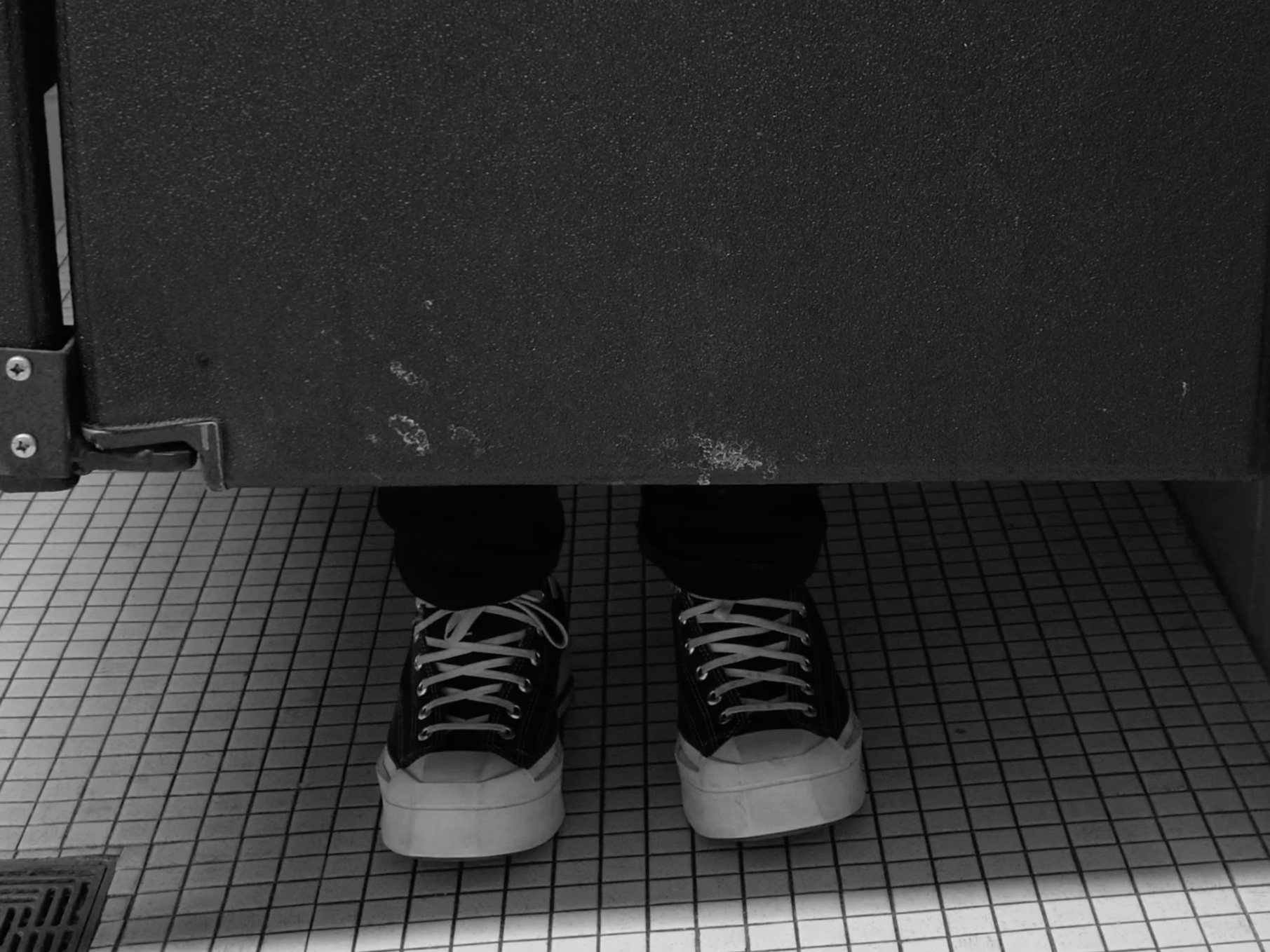
Take the bathroom shot, for example.
It looks complicated, but the solution came from just being a little creative. I locked the tripod legs on top of the door in front of me and angled the camera down to get that overhead view.
Of course, that meant the recorded image was completely upside down. So in post, I flipped the frame 180 degrees to get the final shot. It’s a simple trick that makes the shot look far more complex than it is.
Other shots were just a matter of placing the tripod somewhere, hitting record, and walking away. Simple, but effective.
The Setback: The Incident
There’s a driving scene in the film where a car is pulled over on the side of the road. To shoot it, I parked on the shoulder and set my camera and tripod up on the opposite side of the street to keep them safe.
I needed to swap mics to record audio. As I’m doing that, I see a car approaching in the distance.
Famous last words: “Man, I hope they don’t hit my camera.”
They do.
The car slams straight into my camera, tripod, and microphone.
Somehow, the camera and mic survive.
The lens doesn’t.
It’s broken clean into two pieces.
There’s a dark irony in having your camera gear destroyed while you’re making a film about bullying, loss, and irreversible choices.
I went through a wave of emotions in that moment, but one thing kept pushing through: I had to keep going. The deadline wasn’t moving. The story still needed to be told.
Thankfully, I had another lens. It wasn’t as good as the Tamron, but it worked. I adapted and moved on.
The next three days of filming were a blur of locations, setups, retakes, and constantly checking the clock ticking down to the deadline.
Post-Production
For editing, I used DaVinci Resolve. It let me:
• Cut and assemble the footage
• Add and mix the music
• Do color correction and color grading
• Handle basic visual effects and audio post-production
You might notice the scene where there are two versions of me in the frame. That was done by recording two separate takes and then carefully layering and masking them together in Resolve so they look like they exist in the same space.
Color Grading & Style
The choice to make the film black and white was intentional.
I wanted the look to mirror the emotional state of the main character—muted, heavy, stripped of distraction. I was inspired by classic noir films and especially by Citizen Kane, one of the most influential films ever made. The high contrast and shadows helped emphasize isolation and internal struggle.
This film is very different from what I usually make. Normally, I do comedic videos. This time, I knew I had to approach the subject with as much seriousness and respect as I could.
There are people who face what the character in this film faces.
People who make the decision he makes.
People who don’t get to wake up the next morning and hug their families again.
For some, it feels like they’ve lost everything. Like happiness is gone for good. When you feel like that, it’s hard to see any reason to keep going.
That’s why the message matters.
What I Learned
The film is called “Your Actions Define You” because that’s what I want people to think about when they walk out their door.
No matter how big or small, your actions really do define you—especially in how you treat others. The offhand comment, the joke, the decision to look away instead of step in… it all adds up.
Making this film taught me how fragile everything is: camera gear, schedules, ideas, and especially people. It also taught me that when things fall apart—whether it’s a lens or a person—you have to decide how you’ll respond.
Your actions define you.
On screen. And off.